Showing posts with label Christmas. Show all posts

Wednesday, October 30, 2019

The Great Christian Festival of Halloween and the Problem with Light Parties

Mostly, the various feasts and festivals that the Christian church has come to celebrate over the last two-thousand years trace their origins to either Judaism or the various pagan cultures in which Christianity took root in the early centuries A.D. In light of Christ, existing seasons and festivities were often re-appropriated as a celebration of some specific aspect of the life and ministry of Jesus Christ and of the Christian faith.

Rather than celebrating the Jewish festival of Passover, Christians tend to focus on the events of Christ’s death and resurrection in what has become Easter (though an understanding of both will enrich one’s faith immensely). Pentecost Sunday has come to be a celebration of the outpouring of the Holy Spirit in Acts chapter 2 and is less focused on Shavuot as a celebration of the wheat harvest and Torah.

When it comes to Christmas, the roots of this Christian celebration are not Judaism but rather stem from the winter solstice celebrations of the Roman Empire, and then later, from various Germanic tribes. In this sense, there is some truth to the idea that originally Christmas and some of the pageantry of Christmas finds its origins in pagan celebrations.

But. But where winter solstice marked the darkest dark and the slow turning of the seasons with the promise of the coming of a new sun, Christians subverted this idea and celebrated the coming of a different Son into the darkness of our world. Light and life to all he brings!

Together the various feasts and fasts of the Christian Calendar invite us to orientate our lives around the life of Christ. They even invite us to re-orientate our sense of time around Jesus.

Over time though, secular society does what secular society does, and takes the various Christian feasts, celebrations, and holidays that we have, and slowly but surely commodifies, commercializes, and bastardizes them. In doing so, it’s not just that a particular Christian feast is undermined, but rather that our sense of life being a reality organised around Christ is slowly chipped away at.

We think less of time as a gift, one that allows us the opportunity to simply be - to be with one another, to share life - and to walk a long obedience in step with Jesus. We start see time as a utility and a commodity to be spent – to be leveraged towards maximum productivity. Instead of living in the anticipation of Christ’s coming in Advent, in the celebration of Christ’s birth in Christmas, in the revelation of Christ as Saviour in Epiphany and so on, the framing categories of our life become; work weeks, school terms, university semesters, quarterly reports, annual reviews, the end of the financial year. Ultimately this is anxiety inducing, rather than life giving. 

Selah

In highlighting this, my point is not to rally the troops in some vein attempt to fight against the secularization of Christmas in contemporary society. I’m not trying to organise a “We Say Merry Christmas, Not Happy Holidays” protest march. My point is both narrower and broader in scope. Narrower in that my concern is not how secular society treats Christmas or Easter, only in how we as the Church do. But broader in that if we as Christians settle for a secular perspective on the various feasts and festivals, we lose track of time as sacred, and with it the fullness of Christian vision and theological insight that the Calendar offers as a discipleship tool. We need a renewed appreciation of the Church's liturgical calendar.

Which brings us to the great Christian festival of Hallowe'en!

Under the pantheon of the Roman gods, and in the folk religions of the early Celts and Germanic peoples, festivals were held that marked the seasons. I’ve already mentioned winter solstice. The autumn festival marked the end of the harvest and the beginning of winter. For the Celts this festival was known as Samhain (summer’s end).

These festivals were religious in nature in that as well as marking the season, they were also a liminal time where people imagined the boundary between this world and the otherworld thinned – fairies and ghosts and the souls of the dead could travel between the dimensions. With the souls of the dead supposedly able to return during these kinds of festivals, they became an occasion to consider death, to consider the under-world, to set a table for ancestors whose ghosts would return to visit their homes.

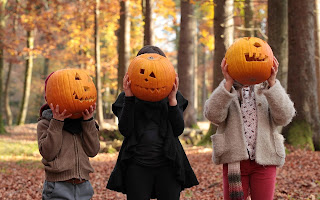
Traditions varied, and traditions evolved – one tradition included dressing as the dead or dressing as characters from the underworld and going door to door to collect treats or do mischief. This practice mimicked the idea that the gods were temperamental and couldn’t be trusted – you better make good sacrifices if you want a good harvest – otherwise they’ll give you nothing but mischief. Another was to carve pumpkins (originally turnips) into scary faces to scare off evil spirits.

The Christian Church looked at all of this and thought, we can do better than this, we’ve a new understanding of death, of what it is to confront death, in the light of Christ. The principalities and powers have been defeated, death is not the final word, the grim reaper is not in charge. And God is not a god of mischief, God is light and life and in him there is no darkness.

And so, the church inaugurated a different festival (as early as the year 609, and then it has evolved from there). Not a one-day festival, but a three-day festival known as All-Hallowtide. A festival designed to sit alongside or exist as an alternative to the various existing festivals of the dead and subvert them in Christ. Hallow means saints, thus we've All Saints Time, and it is a chance to consider and face the reality of death and fear of death we often carry. It is also a chance to remember those who have passed away, saints known and unknown. The three days are October 31st, November 1st, and November the 2nd.

October 31st – Hallowe’en: All Saints Eve, Hallow Eve, Hallow Evening. This day was an invitation to prayer, to renew one’s baptismal vows in the face our fear of death – I’ve already died in baptism, it is no longer I that lives but Christ that lives in me – and was a chance to reflect on our eternal hope in Christ: neither death nor Hades (literally the god of the underworld) are in charge and they do not have the final word in the face of death.

November 1st – Hallow Day: All Saints Day. A time consider the capital “S” Saints and martyrs of church history and to consider their lives as exemplars to us in our own journey. Not celebrity  Christians to follow but faithful saints in the truest sense.

November 2nd – All Soul’s Day. An opportunity to consider the lower-case “s” saints who’ve influenced our lives but have passed away over the course of the last year – friends, family, church members. And then more broadly, those who have influenced our lives but have passed away in years gone by.

All-in-all a chance for the Christian to face death, and, in doing so, to recognise that God is sovereign over death, faithful even in death, and that death has been unmasked as a false god.

Romans 8:35-39What shall separate us from the love of Christ? Shall trouble or hardship or persecution or famine or nakedness or danger or sword? (You could say; shall any sort of mischief come between us and God? No way!) As it is written: “For your sake we face death all day long; we are considered as sheep to be slaughtered.” (I’ve been baptised, it is no longer I that lives but Christ that lives in me!) No, in all these things we are more than conquerors through him who loved us. For I am convinced that neither death nor life, neither angels nor demons, (or fairies, or zombies, or scary pumpkins, or mummy’s wrapped up in toilet paper, or trick-or-treators dressed as the Kardashians) neither our fears for today nor our worries about tomorrow (especially about death, even though we try not to talk about in our modern world, we try and sweep it under the rug, the business of morticians and undertakers) – not even the powers of hell can separate us from God’s love. No power in the sky above or in the earth below, nor anything else in all creation (not even a zombie apocalypse), will be able to separate us from the love of God that is in Christ Jesus our Lord.

Allhallowtide (All Saints Time) with Hallowe’en, All Saints and All Souls, is a chance to cultivate a proper sense of Christian hope and perspective in relation to death – to remember that death is not the final word! Jesus is the resurrection and the life, our promise of eternal life. The story is not over and in the fullness of time, all will be made well, all will be restored, all will be renewed, every tear will be wiped away – and in the resurrection will be re-united– we will gather to break bread together once more. 

And thus, we say; “where oh death is your sting!?!” Not because the pain of losing a loved one is not real, is not heart-breaking, is not without its own kind of sting. We say, “where oh death is your sting!?!” because death is not, ultimately, that which destroys but that which will itself be destroyed. The love of God will conquer sin and death – and resurrection life will prevail.

Which brings us to the problem of Light Parties, (or at least the potential problem of Light Parties – they are really good for little kids). The problem is that secularism triumphs when christians decide that we need an alternative to the Christian festival of Hallowe’en. Especially if the reason for it is a fear of rubber masks, face-painting, toilet paper, and cobwebs made out of cotton wool – the ghouly and ghostly get-up of Hallowe’en. Secularism wins when we decide that we can’t face death with our kids – and the cartoonish representations of death that come with it – and declare faith and hope and the victory of Christ in all things. Secularism wins when we celebrate Jesus as the Light of the World but only with glow sticks in the sanctuary.

Hallowe’en is an opportunity (with our slightly older kids – the ones that have moved on from Bob the Builder) to, paradoxically, through the use of masks, actually un-mask and disempower the various “boogeymen” that creep into our imaginations (as children – and as adults) and fill us with fear. Especially the fear of death.

We’ve a chance to face these fears – through the dressing up and running around, through the putting on and then the taking off of masks, kids get the chance to expose various monsters as make belief. And then, in conversation with parents to recognise that “there is a light that shines in the darkness, and is not overcome,” and “there is a power greater than death and it is Jesus.”

A Christian participation in All Hallow’s Eve, All Saints Eve, Hallowe’en (even the “trick or treating” part of it) and also All Saints and All Souls day is not some sort of compromised glorification of the occult – rather – it is a good time for us to allow death and other things that scare us into our celebrations and conversations, especially with our kids, in order to then unmask them and speak of the life and power of Jesus Christ. When all the masks are taken off we can have conversations about things that scare us, about death, about the power of Jesus. We let the light shine in the darkness – and it is not overcome.  

And then after that, we follow this up with All Saints Day. “You know how people dressed up yesterday as monsters and mummies and Harry Potter characters and Star Wars characters and different super-heroes – do you know who the real superheroes in life are?”  “Nope.” Well let me tell you about Francis of Assisi, or Mother Teresa or your Grandmother and how she loved Jesus and loved people… They are the kind of super-heroes that God thinks are pretty cool. And then you follow that up with All Souls Day and a conversation about a loved one who’s died, and our hope in Christ of resurrection life and the renewal of all things. Death isn’t the final word.


Rather than let secularism subvert Halloween, we leverage Halloween as a Christian opportunity to subvert fear and death!

**I don’t really have a problem with Light Parties. They have their place. Especially with little kids. Have a blast whatever you do! I’m just trying to make a point. We don’t need to have a problem with Halloween either, if we have the conversations with kids that the festival invites. That said, the whole candy from strangers practice is weird.**

Tuesday, December 12, 2017

A Song Beyond Comparison - An Advent Sermon

Mary was pledged to be married to Joseph, but before they came together, she was found to be pregnant by the Holy Spirit. Because Joseph her husband was faithful to the law, and yet did not want to expose her to public disgrace, he had in mind to divorce her quietly.

But after he had considered this, an angel of the Lord appeared to him in a dream and said, “Joseph son of David, do not be afraid to take Mary home as your wife, because what is conceived in her is from the Holy Spirit. She will give birth to a son, and you are to give him the name Jesus, because he will save his people from their sins.”

All this took place to fulfill what the Lord had said through the prophet: “The virgin will conceive and give birth to a son, and they will call him Immanuel” (which means “God with us”). When Joseph woke up, he did what the angel of the Lord had commanded him and took Mary home as his wife.


The Christian Calendar begins with Advent, a season in which we’re invited to entertain the possibility of an alternative reality, an alternative reality that subverts life as we know it. The Calendar doesn’t start with a conference, or a seminar, or a discipleship intensive – the downloading of facts and certitudes, doctrines and truths. It starts with an invitation to imagine other possibilities; new possibilities. This is significant because this whole “following Jesus” thing is about new possibilities. Newness of life, new ways of living, God declaring through Isaiah – “Behold, I am making all things new.”

We’re not always quick to embrace the “new” though. Often it is only in a slower process of re-imaging things that we find an openness to some new possibility begins to come alive. Most of us linger in wistfulness as we consider and re-consider alternative ways of being and alternative ways of arranging our lives. Alternative understandings, newness that is demanded of us, is more likely to shut us down and put us on the defensive; we start to defend the old and resist the new – we even start to resist the idea that there could be anything “new.” Thus ultimately, we’re not taught “into” something new, we’re “imagined” into something new. This is why the best teachers are not those who can explain a subject with great clarity, but those you can capture the imagination of students in regard to the subject at hand.

The Christian Calendar, an annual cycle-of-discipleship based on the life of Jesus, understands this, and begins with a season designed to capture your imagination. We don’t begin with teachings of Jesus, not the miracles of Jesus, certainly not the Cross – that’s a surprising part of the story that comes later. We begin with the excitement and anticipation that God is up to something new in the world, something never seen before, a Messiah, a Christ, a Saviour is coming. And his name will be Jesus and he’ll save people from sin. Imagine that!

This is a challenging idea for those that aren’t very imaginative.

Years ago, some friends and I were at the movies watching the first installment of the long-awaited Lord of the Rings trilogy. The movie closes with Fordo and Samwise in their canoe paddling to the far side of a river. Off they go, all by themselves, carrying the Ring of Power to Mount Doom. In a silent theatre with the closing credits rolling, a friend up mine pipes up; “That could never happen in real life!”


“The virgin will conceive and give birth to a son, and they will call him Immanuel” (which means “God with us”). “That could never happen in real life!” Or, as John puts it, “The Word became flesh and dwelt among us, full of grace and truth.” (1:14). “That could never happen in real life!” Or, as Luke puts it, (with angels singing to shepherds), “Glory to God in the highest, and on earth peace, goodwill toward men!” (2:14).

Could these sorts of things happen in real life?

In our Gospel reading, Joseph has his doubts, of course he does. He has it in mind to quietly and respectfully call off the marriage – a baby conceived by the will of God. “Yep, of course Mary – wink, wink, nod, nod, say no more, say no more.” But then, he has a dream, where an angel speaks to him, tells him its true, all of it. The child will be the Saviour, the one who rescues people from their sins. This is all out of the box, this is something new, but Joseph is open to this newness and takes Mary as his wife.

Sometimes it feels it would be easier to cope with the uncomfortable known than imagine that something genuinely “other” could happen. Sometimes it is easier to imagine things could never change, that’s easier to cope with at times. What we know, even the pain and hurt, can at times be comforting. Imagining Mary had been unfaithful and calling everything off, surely that wouldn’t be as painful as embracing this risky new thing? A virgin birth? The Son of God?

If we can imagine something other than what is, we tend to imagine only a “hyper” version of reality, not an “alternative” version of reality. But this is a failure of imagination. We imagine our lives being turned around because we win lotto – we imagine all the things we would do and could do if our numbers come up and we win the $36 million-dollar power ball – Christmas come! Here though, the world doesn’t change, rather you simply get to place all of your trust in the power of money to turn your life around, rather than trusting in the power of God to make all things new!

This is also why a popular understanding of eternity, rather than a biblical understanding, is ultimately a failure of imagination. Because it doesn’t imagine this world renewed and restored and healed, it imagines another world, a “hyper” version of this world with mansions and crowns for everyone and streets paved with gold in a pearly gate – eternity in a safe and secure gated community. This is little more than a super-sized, upgraded, “hyper world” – birthed in escapism, materialism and consumerism rather than in a biblical vision of a renewed cosmos.

Advent is a season where we are invited to re-imagine the world through the eyes of God. To allow something other, something from elsewhere, from outside of ourselves, outside of the plausibility structures of the world – to capture our imagination and offer an “alternative” vision for the world as we know it. God’s vision for this world.

Paradoxically though, this doesn’t mean we need to look elsewhere or look far off – through a telescope to the edges of the universe, for something distant. Rather, we need to look deeply into the recesses of our own hearts, for the aches, the longings, the hopes we have as humans for a world of peace and joy, that are birthed of God. Hopes that we all carry, though they are easily lost under the baggage of sin and death. Hidden because of pain or heartache, or disappointment and loss, maybe great poverty gets in the way, or maybe great wealth – we can lose sight of God’s vision for this world for many reasons.

Deep down though, I think faith, hope and love is always desperate to spring to life. And, it seems to me, that in the countdown to Christmas, this is a more palatable possibility than any other time of the year.

In The Magician’s Nephew by C.S. Lewis, Digory and Polly, Uncle Andrew, the Cabby and the evil witch Jadis, find themselves present at “the founding of Narnia” where Aslan’s sings the world into being; it’s described as “a song beyond comparison.” It’s a magnificent scene. At one-point, Aslan selects animals to be the walking, talking, animated, stewards of Narnia. Digory and Polly are awestruck when they hear the animals talking to each other and Aslan – it's positively magical.


The Cabby on seeing everything unfold comments; "Glory be! I'd ha' been a better man all my life if I'd known there were things like this." Uncle Andrew sees things quite differently though, he wasn’t awestruck.

Lewis writes: For what you see and hear depends a good deal on where you are standing: it also depends on what sort of person you are. Ever since the animals had first appeared, Uncle Andrew had been shrinking further and further back into the thicket. He watched them very hard of course; but he wasn't really interested in seeing what they were doing, only in seeing whether they were going to make a rush at him. Like the Witch, he was dreadfully practical. He simply didn't notice that that Aslan was choosing one pair out of every kind of beasts. All he saw, or thought he saw, was a lot of dangerous wild animals walking vaguely about. And he kept on wondering why the other animals didn't run away from the big Lion. 

When the great moment came and the Beasts spoke, he missed the whole point; for a rather interesting reason. When the Lion had first begun singing, long ago when it was quite dark, he had realized that the noise was a song. And he had disliked the song very much. It had made him think and feel things he did not want to think and feel. Then when the sun rose, and he saw that the singer was a lion ("only a lion," as he said to himself), he tried his hardest to make believe that it wasn't singing and never had been singing - only roaring as any lion might in a zoo in our own world.

And so, when at last the Lion spoke and said, “Narnia awake,” he didn’t hear any words: he heard only a snarl. And when the Beasts spoke in answer, he heard only barkings, growlings, baying, and howlings. And when they laughed – well, you can imagine. That was worse for Uncle Andrew than anything that had happened yet. Such a horrid, bloodthirsty din of hungry and angry brutes he had never heard in his life.

Uncle Andrew missed the magic. He was all too practical. As Digory puts it earlier in the story; “Grown-ups are always thinking of uninteresting explanations.”

At Christmas time there is a certain “magic” in the air that is hard to miss, but, it’s not impossible to miss. If one wants to you can come up with uninteresting explanations and right Christmas off as consumerism, pressure and commercialization. It’s all just noise, barkings, growlings, baying and howling. Like Uncle Andrew, you can avoid thinking and feeling things you don’t want to think and feel.

But, if one pays attention, you can tune into the magic, the deeper longing embedded within the core of the whole vast Christmas industry, and if you listen carefully enough, discover that there is still a “song beyond comparison” being sung. Trees are decorated, Christmas movies are watched, Christmas lights are set up, gifts are bought and wrapped, cards are written, soldiers fighting pause to play soccer and share cigarettes, even those with only a little do what that can to give to others – ultimately because faith, hope and love still desperately wants to spring to life and is stirring people’s hearts.

While some find it easy to dismiss God, a novel idea, a myth, a theory of everything; dismissing Christmas isn’t so easy. Luther and Nora Krank try to do this in the movie, Christmas with the Kranks, it’s not so easy. Christmas is all-encompassing.

To dismiss Christmas is to dismiss a part of ourselves, it’s to dismiss some of the most wonderful and some of the most enduring aspects of our childhood, and at the same time, some of the most fragile aspects as well (the hopes and fears of all the years, the tears and the laughter). In one sense it is to dismiss the child that still lives inside each of us. To dismiss Christmas is to dismiss the sense that there is more to life than the ordinary and the mundane, that life is also somehow mysterious and magical. It’s to dismiss the possibility that reindeer really know how to fly.


It’s to dismiss that leap in your heart as you wake to another morning only to quickly remember that it isn’t another morning at all – it is a morning as different to any other morning as you can get. And, in doing so, it’s to dismiss the possibility that some way, somehow, someday – this once a year Christmas feeling, could actually become an every day of the year feeling. It’s to dismiss the idea that peace on earth and goodwill to all – might actually be possible.

Which, whether we realize it or not, or accept it or not, is to dismiss the idea that Jesus Christ is actually Emmanuel, God with us, the one who will save us from our sins and make all things new.

How is this all going to happen? How can a baby, born in a manger, be the beginning of some whole new thing that God is doing? Well, that’s the story that unfolds in Epiphany and Lent and Easter and isn’t the issue at this stage of the story. For now, in Advent, the invitation is to re-imagine this world turned right-side-up. And to embrace all of the excitement, anticipation, risk and fear that comes with daring to imagine such a thing.

It’s to imagine new possibilities for your life over the next 12 months.

That, in our lives and in the world – pain and heartache could find healing, that anxiety and worry could fade away, that waring and fighting could give way to peace, that disappointment and heartache could become joy and laughter, that faith, hope and love can actually spring to life. It is an invitation to re-imagine this world and to tune into a song beyond comparison that is being sung today. A song of heaven that still plays in the quiet of our hearts today.

Benediction:
Living God, I pray for my brothers and sisters,
May they know your presence in this season of possibility.
Give them the ability to see as you see – to re-imagine this world
As one made new, reconciled and restored.
Give them a heart that is obedient,
A faith that is kingdom-focused and a love that is neighbourly.
Awaken them to your song, a song beyond comparison
A song that is being sung today.
Act in us, through us, and beyond us,
That we might see a weary world rejoicing.
As we go this morning, may we go in
The grace of the Father
The love of the Son
And the comfort of the Holy Spirit.
Amen. 


Thanks to C.S.Lewis for The Magicians Newphew, Frederick Buechner, Barbara Brown-Taylor and Walter Brueggemann, for shaping elements of the above. 


Wednesday, November 8, 2017

Advent; the Moment Before THE MOMENT

Advent is the four-week season that leads into Christmas; the moment before The Moment. Advent is an invitation to consider words like anticipation, expectation, hope, and waiting. What are you hoping for? What are you waiting for? What are you counting down to? During Advent we’re invited to fix our hearts and hopes on Jesus. We’re invited to join with Joseph, Mary, Simeon, the Wise Men of the East, the shepherds of the field, the people of Israel, in their waiting for the Messiah, for the birth of Jesus 2,000 years ago. We’re invited to consider our own need of Jesus today, to allow an excited anticipation to stir in our hearts as we trust Jesus to show up in our lives in different ways. And, of course, we’re invited to put our trust in Jesus as we consider a world that desperately needs Jesus to come again, to bring peace on earth, and God’s good will here as in heaven. 


Advent starts on the 3rd of December, only a couple of weeks away, so here are some tips to help you to engage in the season as Advent as we prepare and countdown to our celebration of the coming of Christ at Christmas.

1:   Get your hands on an Advent Devotional of some sort. If you Google “Advent Devotional” plenty of options will come up. This year I’m using Walter Brueggemann’s Celebrating Abundance. The Bruegg-Master is always top shelf and was only $3 on Kindle. There are plenty of other great options as well, see… Bonhoeffer and Annie Dillard, N.T. Wright, Richard Rhor, Spurgeon, Tozer etc. There is even one by Heidi Haverkamp called Advent in Narnia.  

2:   During Advent, when you find yourself waiting – for an appointment, in traffic, for the kid's sports practice to finish, for your turn at the supermarket check-out – don’t let it be a moment of stress and impatience; let it be a moment of peace. Celebrate the waiting. Celebrate that things are out of your control. Celebrate that the world doesn’t run according to your time-frames. Celebrate that life is a gift to be savoured not a “to-do-list” that must be completed as quickly as possible. Remember that whatever you are hoping to get to next, isn’t as important as what you think. What is important is peace on earth. Choose the peace of God in that moment, and remember we’re counting down to the one who declares “peace on earth, and goodwill to all.”  


3:   Read one book from C.S. Lewis’s Chronicles of Narnia, let their magic remind you that all of this is pretty “magical,” the gift of a loving God.

4:   Head to your local shopping mall and park yourself somewhere where you can sit and watch and take it all in. Revel in the hustle and the bustle, the decorations, the lights and the people out and about buying gifts for one another. Don’t let the consumerism of Christmas (which is nasty) distract you from the fact that there is something in the air. Even secular people see Christmas as something “other” than ordinary time. Smile when you see people obviously enjoying themselves, humming away to the Christmas tunes. Pray for those that look stressed, anxious, argumentative, consumed by consumerism and what has disintegrated into a silly season. (In regard to consumerism you could watch What Would Jesus Buy?)

5:   Watch a Christmas movie, with your spouse, with your kids, in your flat. Maybe pick one you loved as a child. One that makes you laugh or one that makes you cry. Life goes quick, so pause and enjoy the moment together.


6:   Buy something to either eat or drink that is a genuine treat, something “other” than what you’d normally buy, something even a bit extravagant. And then share it with someone, with strangers or friends. Let it be a delight, a reminder that we are blessed and that God is good. Let it be a sacramental nod to the Marriage Supper of the Lamb; that we’re waiting for Jesus and for a time where we no longer fast but will feast with all being healed and restored.

7:   Simultaneously, ask how you could simplify Christmas. What could you do this year to take some of the stress out of Christmas? What do you need to say “no” to? What pressure to conform do you need to resist? Advent is a chance to intentionally prepare for Christmas and you need not get caught up in the rat-race of the world’s corruption of a festive season into a silly season.  

8:   Appreciate that others are not as fortunate as you. Look beyond your family this Christmas, how could you bless someone in need?

9:   Instead of a Christmas wish list of gifts and toys you’re longing for, hopefully you’ve moved beyond that, take a moment to make a list of spaces and places in your life, in your family, in your work, in your church, where you need the love and light of Christ to shine. Let this be a prayer list for Christmas and bring this before God. An invitation for Jesus to turn up.


10:   Throughout the entire season of Advent, as we count down to Christmas and the coming of Christ, remind yourself again and again, that nothing will truly bring the satisfaction, the fulfillment, the peace, the wholeness, the hope that we all long for in different ways; other than Jesus. That new phone, winning lotto, getting into that new relationship or out of that old relationship may feel life-giving for a moment, but you’ll soon find yourself feeling empty again. Jesus is the reason for the season, and honestly, the only thing that brings fullness of life.


Grace and peace all. 

Sunday, December 22, 2013

Fourth Sunday of Advent @ St Luke's

St Luke's - 4th Sunday of Advent -22nd December 2013:

Introduction to Advent:

Welcome to the 4th Sunday of Advent... 3 more sleeps to go... and then it is Christmas... the celebration of Christ coming into the world, into our story, then, today and tomorrow! Even still though we are waiting patiently, we're learning to wait for what really matters rather than that instant gratification we all so often crave. Jesus comes in his own time and on his own schedule. 


Christmas Reorientation: (stand and read aloud together)

Christmas is coming
Some see this as "the silly season" - as a
time of stress and anxiety
We chose though, not to be consumed by the consumerism.
Christmas is the coming of Christ into the world
Rather than be frantic, we will be still.
We celebrate Jesus, Immanuel, God with us. Everywhere.
A new way of living, a new day has dawned
Though there may be darkness, The Light has come.
We remember that Christmas is hope, peace, joy and love
Christmas is Christ.

Advent Wreath and Candles:

This morning, with our Advent wreath, we're going to light all four candles. Hope, peace, joy, today's candle which is symbolic of love.

The light gets brighter and brighter as we journey forwards towards the coming of The Light of the World.

So this morning we need four kids to come and help light a candle...


Love - Based on Psalm 103 and John 15: (one person reads and everyone else joins in)

Lead: The steadfast love of the Lord is from everlasting to everlasting. 
All:
 The Lord's love endures forever. 

Lead:
This is my commandment, that you love one another as I have loved you.

All:
 Love the Lord with all your heart and love your neighbour as yourself.

Lead:
No one has greater love than this, to lay down one's life for one's friends.

All:
We love because He first loved us. He is the light of the world. He is love.


Worship:

Joy to the World - Issac Watts
Hark the Herald Angels Sing
 - Charles Wesley

Oh Holy Night
 - Adolphe Adam

Interactive: (discussion in small groups with particular focus on including kids and interacting with kids)
In small groups discuss the following questions...
What is your favourite thing about Christmas?
Which word is most meaningful for you at Christmas; hope, peace, joy or love? Why?
What might people find difficult or challenging at Christmas?
Is there a way you could show love to them this Christmas?

Sermonette: (Joseph McAuley)

Matthew 11:2-3
When John heard in prison what the Messiah was doing, he sent word by his disciples and said to him, "Are you the one who is to come, or are we to wait for another?"

Introduction:

Pre-Christian Germanic countries used to celebrate and hold a feast in the middle of winter called Yule. It was held to mark the winter solstice, the time of year when the noon day sun is its lowest. Little work could be done in the winter and now the countdown to better weather started. The celebration would often go for 12 days.

Legend had it that during these times of the year there were more supernatural and unusual occurrences than at other times of the year. Legend even has it that the god Odin, also known as long-beard as he had a big long beard, would lead a Wild Hunt through the sky every Yuletide. His role was to distribute gifts to his people. 

In time though, as the Gospel spread to these regions, this feast evolved to become a celebration of the birth of Jesus. About as early as 354 AD, the celebration of Christmas on the 25th December and the coming of Christ was an official part of the Christian calendar. Yuletide celebrations such as gift giving were re-orientated around the idea of Christ as a gift to the world.

Around this same time, in Asia Minor, lived a man called Saint Nicholas. St Nicholas was a godly man and used his entire inheritance to help the poor, sick, and children in need. He gave in secret, expecting nothing in return. Among other things Nicholas saved young women from slavery, protected sailors, spared innocents from execution, provided grain in a famine and rescued a kidnapped boy.

In his most famous exploit, a poor man had three daughters but could not afford a proper dowry for them. This meant that they would remain unmarried and probably, in absence of any other possible employment, would have to become prostitutes. Hearing of the girls' plight, Nicholas decided to help them, but being too modest to help the family in public (or to save them the humiliation of accepting charity), he went to the house under the cover of night and threw three purses (one for each daughter) filled with gold coins through the window opening into the house.

One version has him throwing one purse for three consecutive nights. Another has him throwing the purses over a period of three years, each time the night before one of the daughters comes of age. Invariably, the third time the father lies in wait, trying to discover the identity of their benefactor. Nicholas learns of the poor man's plan and drops the third bag down the chimney instead; a variant holds that the daughter had washed her stockings that evening and hung them over the embers to dry, and that the bag of gold fell into the stocking.


In time though, Saint Nicholas and his legend merged and evolved with Odin and his legend, to become Father Christmas, Santa Clause, the man with the white beard in the red suit, who lives in the North Pole, flies through the sky on a sleigh and drops gifts down chimneys.

So you've got a Christian bishop who over time as become a magical figure in a red suit. And then you've got a Yuletide Winter Solstice Festival that has become the Christian Christmas, our celebration of the birth of the Saviour. And of course, our 21st Century as seen Christmas commercialized like never before. Pause.  

There is a real blurring of the mystery, the magic, the merriment and the meaning of Christmas.   

But hasn't this always been the case at Christmas? Even at the first Christmas?

- Wise men, Magi from the East, astrologers following star signs.
- Shepherds having supernatural encounters with choirs of angels.
- Jewish expectation that a Messiah was to come who would overthrow Roman oppression and re-establish the throne of David and Jewish rule.
- Herod and the rest of Jerusalem being frightened by reports that a new king had been born; Herod because he is an imposter and has no legitimate claim to the throne, Jerusalem because they are fearful that this could arouse the anger of the Roman Empire.
- Reports though that this new king has been born in Bethlehem of all places, in a manger, with animals, without the pomp and ceremony that one would expect.
- Reports that he is going to save people from their sins.
- A plot to murder this new king ASAP.

Imagine Bethlehem locals at the time, the tanner and his wife that life across the road from the inn without any room. What's going on? What's the meaning of this? How do we figure this out?

Questions that we're still asking 2000 years on amongst crackers, carols, Santa, stockings, trees, tinsel, ham, turkey, differed payments, presents, pressures, nativity scenes, candy canes, Christian rhymes, elves, eggnog, baby Jesus, wise men, the Christmas Grinch. What are we to do with Christmas? What are we to do with the Christ-child, Jesus? Pause.

* At one end of the spectrum some see Christmas as something to be endured, or to 'get through', or even something to be ignored.

I read this week of one Christian declaring their not going to be celebrating Christmas this year as the date for Christmas was chosen to line up with the pagan festival of winter solstice and they are endeavouring to line up their life with biblical standards not questionable traditions.

And yet Christmas is the redeeming of a pagan festival in order to celebrate Christ. It is a legit as it gets.

* At the other end of the spectrum some simply conform to the culture of Christmas as marketed to us by popular media and multi-nationals... struggle to give the right gifts, have the right stuff, throw the right kind of party. Have just the 'right kind of Christmas.'

* There is a third option though, neither disengagement nor whole hearted embrace, each December we can chose to re-tell the Christmas story for what it is: a promise of hope, peace, joy and love, the coming of Christ into our story to set things right.


Each December we can set up an Advent Wreath and light candles and re-tell the story. We can sing carols that remind us of the reason for the season. He comes to make His blessings flow, far as the curse is found, far as the curse is found. We can pack up the kids and take them off to 'The Road to Bethlehem' or on the Christmas lights trail and call in at the various churches that participate and look at the manger scenes and ask questions and tell stories as we drive around.

Rather than fight against Santa or Rudolph or the Elves we can talk about the greatest gift of all. We talk about the reality that every good deed, good thought, good gesture, good intention, good action is ultimately an echo of God's life and God's generosity towards us.

Generosity ultimately displayed in the giving of his only Son, that whoever would put their faith and trust in Jesus would find true life.

But he came in controversial circumstances, a young women betrothed but not married, a challenge to the throne of Herod, a disturber of the peace, without pomp and ceremony. There is a degree of mystery. There is a degree of confusion.

Years on people are still asking, John the Baptist of all people is asking - are you the one who is to come or should we look for another?

Years on we all to often ask the same question. We want Jesus of course to be the Messiah, the Saviour, the answer. And we know of course that he is. And we know enough of the Christmas story to know that he doesn't come as we might always like and hope and expect, or on our time frames.

But all too often we find ourselves looking for other Saviours. More convenient Saviours. More timely Saviours.

Chocolate. A cold beer. A sleep in. A new car. A different house. A career change. A new medicine. A pay rise. Lotto. A new relationship. A new wife, a new husband. A holiday. Time spent on the beach, time spent in a novel. A charismatic leader to follow. Some success. Some fame. Some fortune.

Saviours that are more readily available, more tangible, more suited for our instant gratification. As we get more tired throughout the year it is even tempting to look to Christmas as a saviour rather than the Christ of Christmas.

Is Jesus the one or should we look for another? Jesus answers Johns disciples, essentially, well you figure it out. People can see, people are walking differently, people are being made whole, people are hearing with clarity, people that were dead all over have found a reason to live, there is good news for the poor.

He changes everything. We just all too often fix our eyes on the wrong thing.

Conclusion:

And so we light the Christ candle this morning as well. Normally you'd wait till Christmas day, but we won't be here. It's Christmas, Christ as come, the light of the world. 

When you survey your life today, your hopes, your longings, your heartaches, areas where you need a miracle, where you need healing, where you need answers or hope or peace... It's tempting to look at the small flicker of the what candle and conclude that off the things that Christmas could bring, this is actually the last thing you need.

And yet Christ brings hope, peace, joy and love.

He is the bread of life, you eat and are hungry no more. We eat up at Christmas but it doesn't satisfy.
He has water that we drink and we thirst no more. We drink at Christmas. Some will have headaches. We'll be thirsty again.
He is the light of the world and in him there is no darkness.

We celebrate Jesus birth at Christmas of course. Really though we celebrate that it actually possible for us to experience new birth, new life, new hope, new peace, new joy, new possibility.

Born that man no more may die.
Born to raise the sons of earth.
Born to give them second birth.
Hark the herald angels sing.
Glory to the new-born king.

Communion:

I don't know your situation, your circumstances, your pain, your joy, your heartache, your hope this Christmas. He does. We're going to take communion this morning and as we do I want this to be an opportunity for you to invite Christ afresh into your world....


Tuesday, December 10, 2013

Second Sunday of Advent @ St Luke's

St Luke's - 2nd Sunday of Advent - 8th December 2013:

Introduction to Advent:

So we're in the second week of Advent, we're journeying towards Christmas. We're closer than we we're last Sunday but we're not there yet. We're waiting... Still waiting...


We're learning patience. We're learning to reflect on what really matters. What is most important. What is actually life giving but hidden and what is obvious but often draining.

Miroslav Volf, a famous Croatian theologian posted this on Facebook the other day in regards to the first Advent and countdown to Christmas... "When Emmanuel came, he disappointed the expectations of many; they failed to see that the reality was better than their expectations."

2000 years later, this is all to often, still the reality for many. Unmet expectations and a failure to see that the reality of Christmas is better than their expectations. Advent is a chance to orientate towards Christmas, the true meaning of the season. And of course, at the same time, to reset expectations in the right direction.

Christmas Reorientation: (stand and read together)

Christmas is coming
Some see this as "the silly season" - as a
time of stress and anxiety
We chose though, not to be consumed by the consumerism.
Christmas is the coming of Christ into the world
Rather than be frantic, we will be still.
We celebrate Jesus, Immanuel, God with us. Everywhere.
A new way of living, a new day has dawned
Though there may be darkness, The Light has come.
We remember that Christmas is hope, peace, joy and love
Christmas is Christ.

Christmas Wreath and Candles:

As a part of Advent each year we set up an Advent Wreath with five candles. The four candles around the outside represent hope, peace, joy and love; and then in the middle we have a white Christ candle.

We don't light them all at once though, rather we light them one at a time, as we journey towards the coming of Christ into the world. In doing so we remember the waiting of Advent, we'd love to rush the work of Jesus in our lives and in our world, but all to often waiting is involved.

The light gets brighter and brighter as we journey forwards though.

(invite two kids to come and light last weeks candle and also this weeks candle)


Wait for the Lord - Based on Psalm 27: (one person leads and everyone joins in)

Lead: The LORD is my light and my salvation; whom shall I fear?
All: The LORD is the stronghold of my life; of whom shall I be afraid? 
Lead: I believe that I shall see the goodness of the LORD in the land of the living. 
All: Wait for the LORD; be strong, and let your heart take courage. 
Lead: Wait for the LORD!
All: Wait for the LORD and be at peace.

Worship:

Joy to the World - Issac Watts
Oh Come all ye Faithful - John Francis Wade
Sing Out - Unpublished St Luke's original
Praise the Lord Coda - Edge Kingsland

Interactive: (charades in small groups with particular focus on including kids and interacting with kids)

1. Away in a Manger 
2. Mistletoe and Wine
3. Frosty the Snowman
4. Three Kings from the East
5. Santa Sack
6. A Partridge in a Pear Tree
7. No room in the inn
8. The First Noel
9. Christmas Lights Trail
10. The Grinch

Sermonette: (Joseph McAuley)

So it's the second Sunday of Advent and we continue our countdown to Christmas. We count down to the coming of Christ into the world. We count down to greatest and grandest interruption in human history. Immanuel, God with us, Jesus entering our story and changing everything.

We orientate around Jesus coming 2000 years ago.
Not as expected. Not in majesty. In humility, a baby born in a manger.
But in doing so we look forwards to the coming of Jesus coming into our world today.
We look forward to the reality of Christ coming into and working in our lives and midst today.  

This is of course is the main thing we count down to in our Christmas celebration but it isn't the only thing.

We all countdown to different things; some that we look forward to but also others that are more difficult to navigate. Some of you are perhaps waiting to open intriguing packages. Packages wrapped brightly and sitting under the Christmas tree or hidden in a wardrobe. You might have intriguing packages you've wrapped and your waiting for kids to open them and be delighted. 


Others are looking forward to waking up in a house where all the beds are once again full, with children and grandchildren that have come home for the holidays. 

Maybe you've had a baby this year and you're counting down to their first Christmas, you're counting down to your own real life nativity scene.

For others here though, I know this is a difficult time of year and you look forward with apprehension.

Perhaps there won't actually be presents under the tree this year, or at least not the kind you'd like.

For some there is an empty chair to deal with, a space at the table that won't be taken. There is a stocking that will stay packed away in the box this year. 

The rituals and celebrations of Christmas are so often designed for two or more and yet this Christmas perhaps it's starting to sound like one hand clapping and it's just not the same.

Christmas for some is the season when you wait to see if the hurt has let up any from this time last year. You want it to so that you can get on with your life. At the same time, you don't want it to, scared it might mean you've stopped caring.

For good or for ill, Christmas functions like a time machine that takes us back to every other Christmas you've had.

- you think of things that were that you hope to replicate and create again
- you think of things that were and that won't ever be again
- you think of things that were supposed to be but actually never were, ways in which Christmas failed to be what you hoped or expected it to be.

Christmas is a mixed bag for all and thus it's no wonder there is a hum, an atmosphere, a buzz at Christmas. 

Christmas is a space in time where our dreams and memories and longings and heartaches come to the surface. Our hopes and fears for all the years are met in thee tonight.

There is this idea that in amongst the good, the bad or the ugly, the possibility of hope, peace, joy and love exits. It's in the air; there is something in the air.

Francesca Battistelli puts it quite well in her song Heaven Everywhere...

'
I hear the bells, they’re ringing loud and clear. You can’t help but love this time of year. It’s Christmas time, there’s something in the air. There’s a little bit of heaven everywhere. Somehow there’s a little more of love. And maybe there’s a little less of us. Or maybe we’re just slightly more aware. There’s a little bit of heaven everywhere.'

You get a sense of this at Christmas. Even in the ordinariness, even in what we might describe as the secular rather than the sacred.

- The pictures and images that marketers offer us of families holidaying, of Christmas dinners being enjoyed.
- The aimless wanderings through shopping malls when you've forgotten what you're looking for and for who.
- High school kids, exams finished, holidays started, clogging up the beaches, Starbucks and the cinema.
- Staff break ups and parties. 

Many of course sense this but put it down to the festivities of the season which brings out the best in people. It's holiday time. The year is nearly done. They'll be presents, food, and drink. Time to make merry and be merry.

I however, to use the words of Aslan in The Lion the Witch and the Wardrobe, am convinced that Christmas celebrates - a deeper magic from before the dawn of time.

"... though the Witch knew the Deep Magic, there is a magic deeper still which she did not know. Her knowledge goes back only to the dawn of time. But if she could have looked a little further back, into the stillness and the darkness before Time dawned, she would have read there a different incantation. She would have known that when a willing victim who had committed no treachery was killed in a traitor's stead, the Table would crack and Death itself would start working backwards."


Christmas celebrates the birth of the one in whom there is no treachery.
The one in who being without sin decides not to cast a stone. Decides not to condemn.
The one who lays down his life in order that others would find life.
The one in whom the curse of death is reversed and in who resurrection life comes.

Christmas is the celebration that a deeper magic is at work in the world; Christ as come.   

Christmas reminds us that the coming of Jesus makes a difference and can make a difference today. 

And so, in amongst the hustle and bustle of Christmas.
The Christmas carols and the Christmas chaos.
The merry making and the migraine managing.
We hope to experience, to taste, to rest in the hope, the peace, the joy, the love, of Christ. 

However different Christmas is for each of us, we all wish for, hope for, look for this time of year to be a moment where we are calmer, more centred, more at ease with ourselves, with others, with Christ.

We hope to rise up above any heartaches of the year just gone.
We hope to keep our head up above water.
We hope to step up out of the silliness of the season.
We hope that Christ this Christmas can somehow lift us up out of all the 'stuff' even if just for a moment of peace, a moment of transcendence, to a place where the veil between heaven and earth is thin and everything is beautiful and focused and just right. Just right, like a Christmas card!

In reality though, even the pictures on our Christmas cards are just moments caught in time. If we could see past the edges we would probably see some pretty familiar sights. If we could rewind a little or fast forward a little we'd discover the picture quickly changes.

Like the family photo you have that is just right. Mum and Dad yelling at the kids, threatening, promising, bribing. Quickly now, smile, snap, great photo, back to craziness.

What I'm getting at is that even the very best Christmas cards, even the very best paintings of the Christmas scene, Emmanuel, God with us, baby Jesus and his family, the ones where the artist has really focused on the softness of the baby's skin, the warm bodies of the animals standing around him heating the air with their breath, even those pictures do not tell the whole story.

The story is really more like the messiness of life that we all know and experience.
The town was clogged with travellers, none their by choice.
The emperor wanted them all counted and taxed and couldn't have cared less where they slept.
Accommodation is at a premium. In fact it's all booked.
Joseph like to be 'spontaneous' and hasn't jumped on wotif.com/beth to book ahead.
Mary about to go into labour ends up in a manger with a feeding trough and farm animals.
The baby is born and wrapped.
And then a photo is quickly taken (or imagined).

Starlight streaming down.
Ox and donkey are watching.
Goats of to the side.
Dog is sitting still.
Doves up on the shelf.
Mary, I know, isn't looking like Lisa was after she'd just given birth, Mary's got it on, Revlon and all.  She's positively glowing.


I wish there was a follow up scene.

Goats start on the basket of food.
Dog starts up at the sheep.
Donkey and ox starting trying to eat the hay and get the corner of the blanket in their mouth.
Doves flutter and poo on Joseph's shoulder.
Baby starts crying. Mary starts crying. She wants her mum. Joseph is doing his best. They're both hurting and a bit worried and cold.

Where is God?

Well God is still right there, in Jesus, right in the middle of everything.
Hope, peace, joy and love.
In the peaceful manger scene.
In the more realistic manger scene.
In the best of times and in the worst of times. Jesus has entered the story and the story has changed forever.  

It's God with us. Not God up there somewhere who answers our prayers by lifting us up out of our lives, but the God who comes to us in the midst of them, however ever far from home we are, however less than ideal our circumstances, however much or little our lives reflect the Christmas cards we send and receive.

Christmas doesn't lift us up out of our circumstances.
Christmas isn't a way of masking and covering over the daily realities of normal life.
Christmas is Christ coming right into the midst of our lives.

We find hope and peace and joy and love, but not as we might have prayed for or expected.
Not in escaping our lives but in allowing Christ into them all over again.

There are no escalators to heaven at Christmas.
Everybody 'up there' is coming down, to here, to this place, to this context, to this world, to these circumstances, into our stories, the good parts, the bad parts, the orderly parts and the mixed up and muddled parts.

At Christmas we discover that God has come to make his home in our arms.
We discover that Bethlehem is wherever we are on Christmas day.
Whether we find ourselves having booked luxury accommodation or whether we find ourselves in a less than ideal stable. 

Charles Spurgeon said that - 'Joy is peace dancing and that peace is joy resting.'

This Sunday of Advent is about joy at rest, it's about peace.
Something that in life can be all to illusive.

Can I encourage you to take a moment to be still and discover peace this week.
Hustle and bustle and craziness and a Christmas countdown and things that need organising and, and, and...

Be still, shut the noise out, poor a glass of wine, turn all the lights off except the Christmas tree.

You might at first simply discover yourself; anxiety, worry, doubts, fears, all sorts of ways in which you actually enjoy the noise more than the silence and the hustle more than the peace.

But if you be still a little longer, maybe with a carol playing super quietly in the background, you'll discover that at Christmas, even as at the Cross, there is a deeper magic going on. That God's heart, God's desire, is to enter into your world, into your story and ultimately bring hope, peace, joy and love. 

Be still and know. Hope, joy, love and peace are found him tonight.

Grace and peace.  

(Special thanks to Barbara Brown Taylor for contributing some of the shape and phrases of this talk. Home By Another Way (chp - Past Perfection).